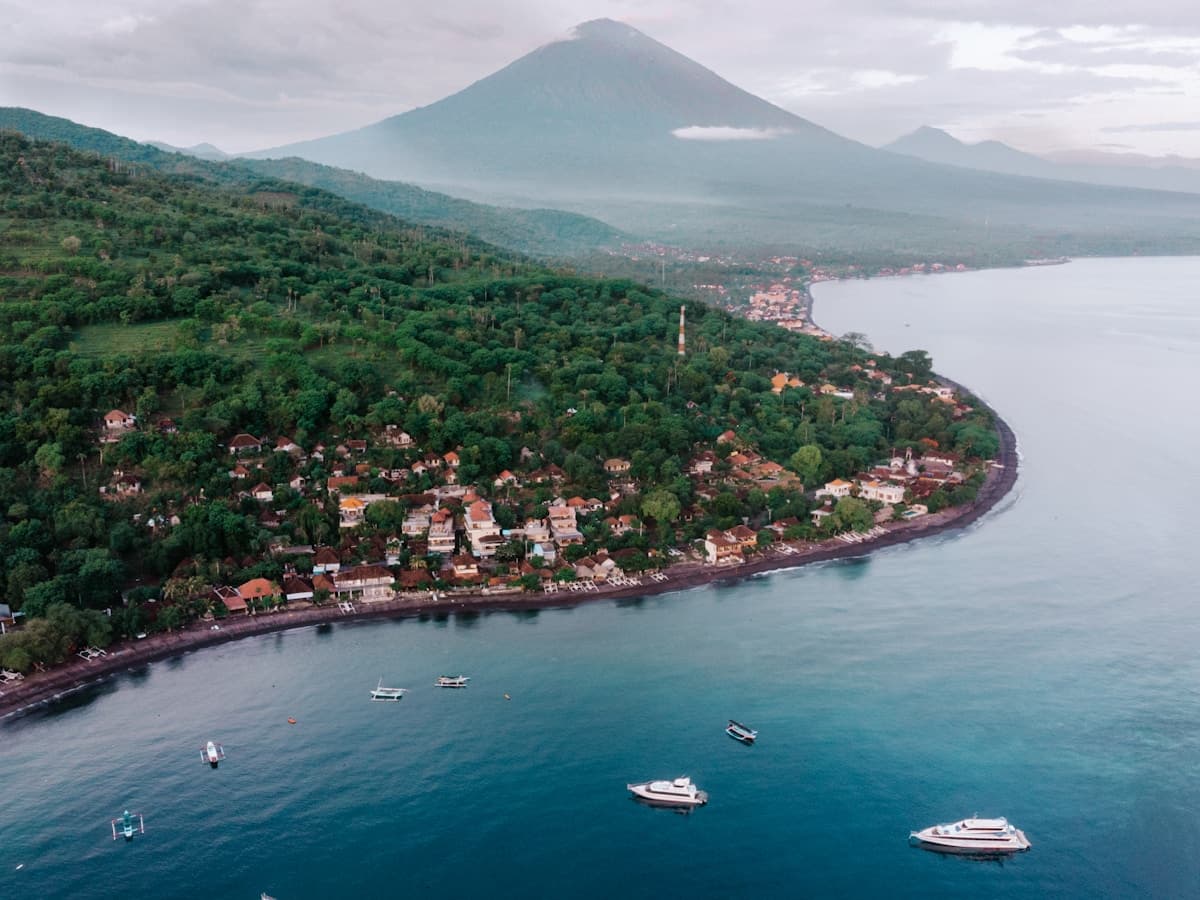
A brief history of Amed
Amed is not a single village but a collective name for a string of six fishing communities — Amed, Jemeluk, Bunutan, Lipah, Selang, and Banyuning — that run along 15 km of the Karangasem coast. The region was one of the last parts of Bali to develop any tourism infrastructure, remaining almost entirely off the traveller circuit until the 1990s. The reason was the same factor that now makes it distinctive: it sits on the dry eastern side of Agung's rain shadow, receives less rainfall than the south, and the volcanic soil supports salt farming and fishing but not the rice agriculture that defines the rest of the island.
The 1963 eruption of Mount Agung, which killed more than 1,500 people and displaced tens of thousands, struck hardest in the eastern flank — the villages of Amed sit precisely in the zone most affected. The eruption also pushed the USAT Liberty, a WWII cargo ship that had been beached at Tulamben since 1942, into the sea. The wreck became, paradoxically, the catalyst for the region's tourism development: divers discovered it in the 1970s and began arriving specifically for it, establishing the dive resort infrastructure that later drew snorkellers, freedivers, and eventually the broader traveller community.
The traditional salt industry that gives Amed its visual identity — the black-sand beach lined with hollow palm-trunk evaporation columns and clay drying trays — predates the Dutch colonial period. Amed salt was traded across the Lombok Strait and up the east Bali coast for centuries, and the petani garam (salt farmers) continue the same process today, though younger generations increasingly leave for work in the south. The combination of the active fishing fleet, the salt pans, and the Agung backdrop creates a landscape found nowhere else on the island — and one that rewards travellers willing to make the two-hour drive from the southern resorts.
Best time to visit Amed
Amed sits in the rain shadow of Mount Agung and receives significantly less rain than the south and west of Bali. The dry season brings ideal visibility for snorkelling and diving; Agung's summit is clearest in the heart of the dry months.
Dry season — April to October
Best underwater visibility — 15–20 m in June to September. The USAT Liberty wreck is clearest in this window. Mount Agung summit climbs are only attempted in the dry season; July–October gives the highest success rate for clear summit views. Salt farming is most active May–October.
Wet season — November to March
Occasional rain but rarely all-day. The reef is still snorkellable on calm mornings. Visibility drops to 8–12 m near the wreck. Agung climbs are not recommended — cloud sits on the summit most days and rain makes the volcanic trail dangerous. Amed is quiet and cheap in these months.
Sweet spot
May–June and September: excellent visibility, Agung still clear in the early morning, reef at its best, and none of the July–August peak-season dive crowds from south Bali. Amed never gets truly overwhelmed — even peak season feels quiet compared to the south.
Local notes
- The drive from the south coast to Amed is 2–2.5 hours via the coastal road through Candidasa, or 2.5–3 hours via the inland Kintamani route. Both are scenic but slow — leave early.
- There are ATMs in Amlapura (20 km south) and occasional ATMs in Amed village — bring sufficient cash for your stay.
- Salt farming is only active in the dry season. If you arrive in the wet season, the salt pans will be empty.
Money & practical tips for Amed
Getting there
Amed is 95 km from the airport — about 2–2.5 hours by car via the coastal road through Candidasa and Amlapura, or longer via the Kintamani inland route. A private driver is essential; there is no reliable public transport to Amed. From Ubud, the drive via Kintamani and the east coast is one of Bali's most scenic routes.
Dive planning
Every dive shop in Amed runs day trips to Tulamben wreck, and most also dive the local Amed reef and the deeper sites around Jemeluk point. PADI courses are available in Amed — the Liberty wreck is the world's best Open Water training site. Book dives through your accommodation or at any of the shops on the beach road.
Getting around
The six villages of Amed are spread over 15 km — scooter rental (IDR 60–80k/day) is the right way to explore them. A scooter also makes the Tirta Gangga and Lempuyang day trips easy without paying for a private car.
Where to stay in Amed
Accommodation in Amed clusters into the small beach villages that line the 15 km coastal road from Jemeluk to Banyuning. There is no central resort strip — each village has its own character and reef access. Jemeluk is the most developed and most convenient; Lipah and Banyuning are quieter for travellers wanting solitude.
Budget
USD 15–50 / nightJemeluk village
The most walkable part of Amed — guesthouses are a 2-min walk from the reef and the Jemeluk bay beach. Simple bungalows with garden or sea view. Most include breakfast.
Lipah / Selang
Quieter villages 8–10 km east of Jemeluk with cheap bungalows and their own house reefs. Fewer restaurants but a genuine fishing village atmosphere.
Mid-range
USD 50–180 / nightJemeluk beachfront
Small boutique hotels and dive resorts directly facing the bay with pools, in-house dive centres, and reef access from the garden. The most convenient base for both the Amed reef and the Tulamben wreck day trip.
Tulamben village
15 km north of Amed — dedicated dive resorts with shore access to the USAT Liberty wreck. The right choice for divers who want multiple dives per day on the wreck without a 30-min drive each way.
Amed FAQ
?How many days should I spend in Amed?
Two to three nights is ideal. Day one: arrive and snorkel the Jemeluk reef. Day two: early Tulamben wreck dive, afternoon at Tirta Gangga or Lempuyang. Day three (optional): salt farming morning, then drive out. Serious divers often stay longer.
?Is Amed good for non-divers?
Yes — the snorkelling is excellent without any diving certification, and the USAT Liberty's bow section is in 5 metres where snorkellers can see it clearly. The wider area (Tirta Gangga, Lempuyang, Agung views) is entirely accessible to non-divers. Amed is one of the few east Bali destinations worth visiting even if you never enter the water.
?Can I climb Mount Agung from Amed?
The Pura Pasar Agung trailhead on the south-east flank is about 30 minutes from Amed and is the most popular starting point. The climb requires a guide (mandatory) and should only be attempted in dry season (July–October). It is a hard, dark, steep ascent — be fit, be honest about your ability, and start no later than midnight for the summit sunrise.
?How do I get to the USAT Liberty from Amed?
Tulamben is 15 km north of Jemeluk — a 25-minute drive. Any dive shop in Amed can take you there and back with full guide and equipment. Alternatively, stay a night in Tulamben to do the legendary pre-dawn dive before day-trippers arrive.