A brief history of Ubud
Ubud takes its name from the Balinese word ubad, meaning medicine. For centuries the valley was famed for its healing herbs and traditional healers, and its ruling Sukawati dynasty packed the royal palace — Puri Saren Agung — with dancers, painters and shadow-puppet masters. Temple ceremonies and palace performances that began as royal patronage are still staged at Puri Saren every evening.
Everything shifted in 1927 when German painter Walter Spies arrived and never really left. He befriended the king, built a studio above the Campuhan river gorge and started drawing the European art world in. Dutch painter Rudolf Bonnet followed. Together they co-founded the Pita Maha movement, helping Balinese craftsmen reach international collectors and develop the vivid, god-and-demon style — dense jungle, intricate ceremony — that still fills the galleries lining Jalan Hanoman today.
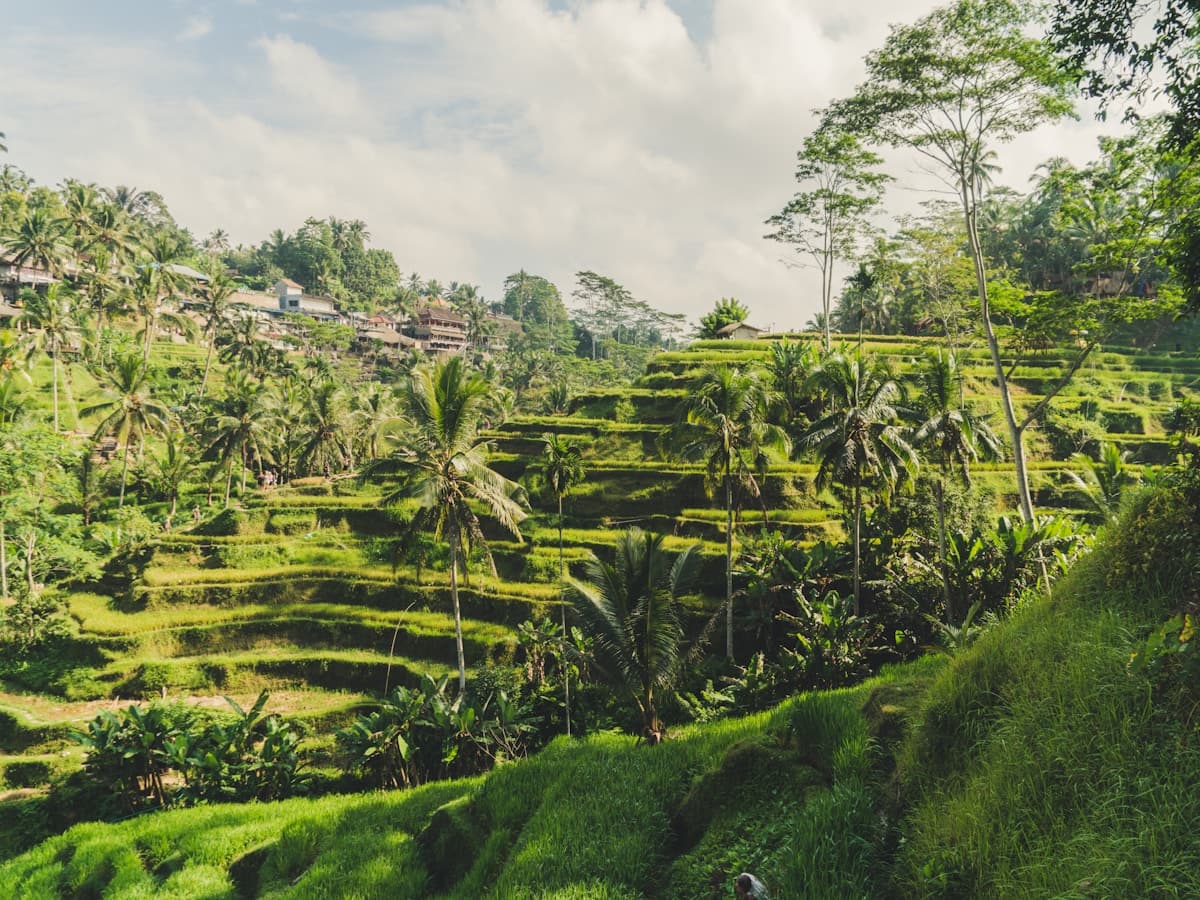
The rice terraces they painted are older still. Tegallalang's stepped paddies are maintained by a communal irrigation system called subak, in continuous use for over a thousand years and now a UNESCO World Heritage site. Fourteen-century temples inside the Monkey Forest, the Kecak fire dance at Pura Dalem Taman Kaja, the ridge path above Campuhan where Spies once walked — Ubud's draws are not beaches. They are layers of living culture you can walk straight through.
Best time to visit Ubud
Ubud has the same two seasons as the rest of Bali — dry (April–October) and wet (November–March) — but the inland location and altitude (~200–600m) change the picture in important ways.
Dry season — April to October
Clear mornings, lower humidity, the rice terraces are at their most photogenic in the May–June planting cycle and again in the August harvest. July–August is peak: book accommodation 2–3 months ahead and expect 9am crowds at Tegallalang.
Wet season — November to March
Short, heavy afternoon downpours rather than all-day rain, and Ubud is noticeably greener than the south. Trade-offs: river rafting and waterfalls run high (some get closed for safety), Mount Batur sunrise hikes are often clouded out, and leeches appear on jungle walks. Prices drop 20–40%.
Sweet spot
Late April / early May and late September / early October — dry weather, rice paddies still green, no peak-season pricing.
Local notes
- Ubud sits 25–35°C year-round; nights can drop to 20°C, so bring one light layer.
- Galungan and Kuningan (Balinese 210-day calendar) bring island-wide ceremonies — beautiful, but most shops, drivers and some restaurants close for 1–2 days. Check the date before booking.
- Nyepi (Balinese Day of Silence, March) shuts the entire island for 24 hours — no flights, no transport, no leaving your hotel. Plan around it.
Money & practical tips for Ubud
Currency & ATMs
Indonesian Rupiah (IDR) only. ATMs are clustered along Jalan Raya Ubud and Jalan Hanoman; use bank-branded ATMs inside lit lobbies (BCA, Mandiri, BNI) and skip standalone street machines. Withdraw the daily max (typically IDR 2.5M / ~USD 160) to amortise the ~IDR 25–50k foreign-card fee.
Cash vs card
Cafes, museums and mid-range restaurants take cards; warungs, markets, taxis, scooter rentals and most temples are cash-only. Carry small notes (5k / 10k / 20k IDR) for parking, donations and water.
SIM / eSIM & connectivity
Telkomsel has the strongest coverage island-wide. Buy a tourist SIM at the airport kiosk or in central Ubud (~IDR 150–250k for 20–30 GB / 30 days). eSIMs (Airalo, Holafly) work fine and skip the registration hassle.
Scooter / motorbike rental
USD 5–8 per day, typically with one helmet. You legally need a valid international driving permit (IDP) with a motorcycle endorsement — police checkpoints around Ubud do stop foreigners. Insurance on cheap rentals is minimal; ride sober, in shoes, and avoid riding at night.
Temple etiquette
A sarong and sash are required at every temple — most rent them at the gate for IDR 10–20k. Cover shoulders and knees. Women who are menstruating are asked not to enter temple inner courtyards (a sincere local belief, not a tourist quirk).
Bali Tourist Levy
International visitors pay a one-time IDR 150,000 (~USD 10) tourist levy. Pay online before arrival via the official Love Bali portal — much faster than the airport queue.
Drinking water
Tap water is not potable. Many Ubud cafes and a few accommodations have refill stations (often free or IDR 5k) — bring a reusable bottle to avoid the plastic-waste problem the island is openly fighting.
Tipping
Not expected, but appreciated. Mid-range restaurants often add a 10% service charge on the bill ("++"). Round up taxi fares, and IDR 50–100k per day is a fair tip for a private driver.
Where to stay in Ubud
Ubud's accommodation clusters into walkable central streets, jungle-edge lanes a short ride out, and rice-field villas. Pick by neighbourhood, not just brand — distance changes daily life a lot here.
Budget
Under USD 35 / nightJalan Goutama / Jalan Goutama Selatan
Quiet lanes one block off Jalan Raya — guesthouses with breakfast, walk to Monkey Forest, palace, market and dozens of cafes.
Jalan Bisma (south end)
Family-run homestays with rice-field views and pools, still 10 minutes' walk into central Ubud.
Mid-range
USD 60–150 / nightPenestanan
Hill village west of the river — boutique villas with private pools, painters' lanes, walking distance to Campuhan Ridge.
Nyuh Kuning
Quiet traditional village just south of the Monkey Forest with mid-range villas around a banyan-shaded square.
Luxury
USD 250+ / nightSayan / Ayung River valley
Resort row above the Ayung gorge — infinity pools facing untouched jungle, big-name brands and a ~15 min drive into town.
Payangan (north Ubud)
Forest and rice-paddy luxury 25–40 min north of town — best for travellers who want absolute quiet and don't mind needing a driver for every meal.
Ubud FAQ
?How many days should I spend in Ubud?
Three to four nights is the sweet spot. That's enough for the central walks (Campuhan, Monkey Forest, palace), one rice-terrace morning, one waterfall day and either a temple day-trip or a Mount Batur sunrise hike, without doubling up on similar sights.
?Is Ubud worth visiting if I came to Bali for the beach?
Yes — Ubud is the cultural counterweight to the south's beach clubs. Most travellers split a week as 3–4 nights Ubud + 3–4 nights on the coast (Canggu, Seminyak or Uluwatu). Going inland first is usually better; you arrive curious and leave rested.
?Is Ubud good for solo travellers?
It's one of the easiest places in Bali to travel solo. Yoga studios, group cooking classes, the Saturday market and shared rides to waterfalls all make it natural to meet people.
?How do I get from Ubud to Canggu, Seminyak or the airport?
By private driver (USD 18–30, 1.0–1.5 hours) or Grab/Gojek (USD 12–20). Shared shuttles (Perama, Kura-Kura) cost USD 5–8 but stop multiple times and take 2+ hours.
?Which apps should I use to get around Ubud?
Grab and Gojek are the two main ride-hailing apps in Bali. Both work in Ubud — download them before arrival and top up in-app or pay cash to the driver. One important caveat: local taxi cooperatives restrict pickups in a few central spots (near the palace and main market). If the app shows no drivers, walk one street over to a main road and try again. For full-day trips to Tegallalang, Tirta Empul or Mount Batur, hiring a private driver through your hotel (USD 35–50 per day) is more practical than hailing multiple rides.
?What should I do if I lose my passport in Ubud?
Go to the nearest police station and ask for a written police report (Surat Keterangan Kehilangan) — every embassy requires this before issuing an emergency travel document. Your hotel reception can usually help arrange transport and translate. Embassies and consulates are in Denpasar and Sanur, roughly 45–60 min from Ubud: US citizens can call the Bali Consular Agency at +62-361-233-605; Australian citizens contact the Consulate-General in Bali at +62-361-241-118; most European nationals should check their government's travel page for the Denpasar consulate contact. Keep a photo of your passport on your phone as a backup.
?Is there a clinic or hospital near Ubud if I get sick?
For minor issues — stomach bugs, cuts, mild fever — Ubud Husada Clinic on Jl. Raya Ubud sees walk-in patients and has English-speaking staff. For anything more serious, Bali International Medical Centre (BIMC) in Kuta is the nearest internationally accredited 24-hour facility, about 45 min by car (+62-361-761-263). Save your travel insurance emergency line before you arrive — it's the most important number to have offline.
?Do I need to book Ubud accommodation in advance?
In dry season (April–October) and around the Christmas/New Year window, yes — book 1–3 months ahead, especially for Penestanan and Nyuh Kuning villas. In wet season you can usually arrive and find good last-minute rates.
?What should I wear in Ubud?
Lightweight, breathable clothing. Bring at least one outfit that covers shoulders and knees for temples, walking shoes for ridge walks and waterfalls, and a thin layer for cooler nights at higher villas.