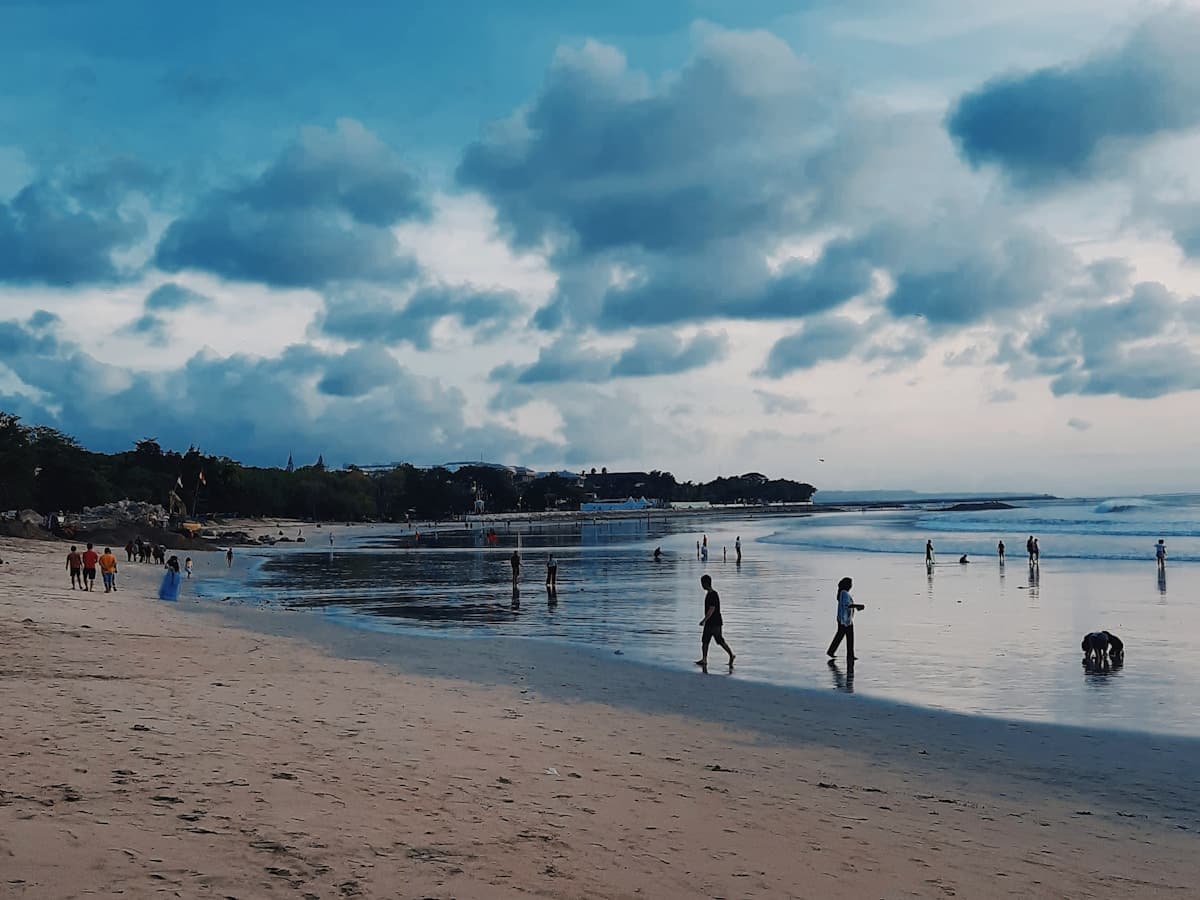
A brief history of Kuta
Kuta was a trading port long before it was a beach town. In the early 19th century the bay was used by Balinese merchants and European traders exchanging slaves, opium and rice — a commerce that made local rajahs wealthy and drew the Dutch colonial administration close. A Danish trader named Mads Lange set up a trading house on the beach in 1839 and spent two decades brokering deals between Balinese kingdoms and colonial powers before dying, possibly poisoned, in 1856. His tomb still stands near the main road. By the time the Dutch consolidated control over Bali in the early 20th century, Kuta was a small fishing and farming settlement living quietly on the beach.
Tourism arrived almost by accident. In the 1930s a small group of Western artists and intellectuals drawn to Bali by its Hindu culture — friends of the Ubud-based painters Walter Spies and Rudolf Bonnet — discovered that Kuta's beach was extraordinary: long, flat, west-facing, with warm water and a manageable shore break. A Californian woman named Koke Manx opened the first tourist bungalows in 1936 and began promoting Kuta's surf to a small international clientele. The experiment was cut short by the Japanese occupation of 1942, and the independence struggle that followed. Bali was not a tourist destination for another two decades.
The modern Kuta was largely built by Australian surfers and budget travellers in the 1970s. Hippie trail travellers stopped off on their way to and from Australia; local families converted fishing sheds into guesthouses; Poppies Lane evolved organically from a path through coconut palms into the dense restaurant-and-shop alley it is today. By the 1980s Kuta had the package-holiday infrastructure that has defined it since — an international airport next door, beach hotels at every price point, and Jalan Legian as its commercial spine. The 2002 bombings killed 202 people and briefly emptied the beach, but Kuta recovered faster than anyone expected. The memorial on Jalan Legian is the most visible reminder that the resort town's easy surface has a harder story underneath.
Best time to visit Kuta
Kuta's beach-break surf is most consistent in the dry season, but the area is busy year-round and less weather-dependent than Ubud or the surf spots further south.
Dry season — April to October
Best surf conditions and reliable sunshine. July–August is the peak of all peaks — the beach is crowded from 9 am, hotels charge top dollar and Poppies Lane is wall-to-wall at night. Book everything well in advance.
Wet season — November to March
Afternoon showers, bigger and messier surf. The shopping malls, restaurants and bars stay full year-round — Kuta is less weather-dependent than anywhere else in Bali because it is not primarily an outdoor-activities destination. Prices drop 20–35%.
Sweet spot
May–June: surf is clean, crowds are manageable and prices are reasonable. Good window for families who need school-holiday timing but want to avoid the July–August chaos.
Local notes
- Airport noise is constant in Kuta — planes land over the beach. Not a problem if you're out all day, but worth knowing before booking a beachfront room.
- Rip currents are present year-round; swim between the flags and only at patrolled sections.
- Kuta is the most tourist-dense part of Bali — petty theft and scams (fake taxis, unofficial money changers) are more common here than elsewhere. Use Grab, use bank ATMs, and double-check change.
Money & practical tips for Kuta
Taxis & getting around
Use Grab or Gojek — unofficial taxis at the airport and outside malls routinely overcharge. The airport's official taxi rank (fixed price, meter-based Bluebird) is a safe alternative for the first ride. Kuta is flat and walkable between its main areas; the beach path from Kuta to Legian takes 30 minutes on foot.
Money changing
Kuta has a notorious network of money changers that appear to offer exceptional rates but use sleight-of-hand to shortchange customers. Use bank-branded ATMs (BCA, Mandiri, BNI) or the official PT Dirgahayu exchange counters instead. Never change money on Poppies Lane.
Shopping & haggling
Fixed-price shops (Beachwalk, Discovery Mall, branded surf shops) are hassle-free. Street market and warung prices are negotiable — start at 40–50% of the asking price and meet in the middle. Never feel obligated to buy after browsing.
Where to stay in Kuta
Kuta's accommodation runs from IDR 150k-a-night fan rooms to beachfront resort hotels — and genuinely every level in between. Location matters less here than in Seminyak or Uluwatu because the area is flat and walkable, but the difference between a Poppies Lane guesthouse and a beach-road hotel is not just price — it is noise level and atmosphere.
Budget
Under USD 30 / nightPoppies Lane I & II
The classic backpacker base — fan and air-con guesthouses from USD 15/night, dinner on your doorstep, 5-min walk to the beach. Noisy until midnight but the most social option in Kuta.
Jalan Benesari / Jalan Werkudara
The parallel lanes south of Poppies — same budget prices, slightly quieter after 11 pm, same easy beach and restaurant access.
Mid-range
USD 40–120 / nightLegian (Jalan Padma area)
The step up from Kuta proper — cleaner streets, mid-range hotels with pools, a 10-min walk to Kuta beach and Waterbom, and noticeably less nightlife noise.
Kuta beachfront (Jalan Pantai Kuta)
Pay a mid-range premium and walk straight onto the sand — best for families who want simplicity and are happy to pay for the convenience of a direct beach exit.
Luxury
USD 150+ / nightLegian beachfront / Double Six area
The top end of Legian heading into Seminyak — larger resort hotels with full facilities, direct beach access, quieter than Kuta proper and a walkable start to the Seminyak strip.
Kuta resort hotels (near Beachwalk)
Large international-brand hotels clustered around Beachwalk Mall — good facilities, easy airport transfers, best for one- or two-night stopovers rather than longer stays.
Kuta FAQ
?Is Kuta safe for first-time Bali visitors?
Generally yes, though it requires more vigilance than other parts of Bali. The main risks are petty theft on the beach, unofficial taxis, and dodgy money changers on Poppies Lane — all easily avoided by using Grab, bank ATMs and licensed exchange counters. The beach is well-patrolled with lifeguards and a flag system.
?How long should I spend in Kuta?
Two nights is enough to see the beach, try a surf lesson, visit Waterbom and eat your way through Poppies Lane. Many travellers use Kuta as a one-night buffer on arrival or departure — it's 10 minutes from the airport and has every price range of accommodation.
?Is Kuta good for families?
Yes for older kids — Waterbom is genuinely excellent, the beach is patrolled, and the food options are the most varied and accessible in Bali. For very young children, the nightlife noise and dense crowds can be tiring; Nusa Dua or Sanur offer a calmer family base.
?What is the difference between Kuta and Legian?
Legian is the next beach strip north of Kuta — same beach, slightly quieter, slightly fewer vendors and a more relaxed nightlife scene. The border is blurry and most visitors don't notice the transition. Legian prices run 10–20% higher than Kuta for comparable rooms.